.png)
âUkraine is grateful to the United States for its overwhelming support,â he said. âI call on you to do more.â
The Biden administration has resisted Kyivâs call to establish a no-fly zone in Ukraine, a measure that has little bipartisan support in Congress and one that U.S. officials fear could inflame tensions and risk a broader global conflict with nuclear-armed Russia. The White House is, however, set to announce $800 million more in security assistance Wednesday, a senior administration official said, as part of a government spending bill President Biden signed Tuesday that will provide $13.6 billion in new aid to Ukraine. Previous U.S. assistance has included shipments of antiaircraft and anti-armor systems.
Russian Foreign Minister Sergei Lavrov said Wednesday that there is âhope for reaching a compromiseâ with the Ukrainian delegation in peace talks, echoing comments by Ukrainian officials that progress had been made. Lavrov, speaking in an interview with the Russian television channel RBC, said he was basing his assessment on the view of the Russian negotiators. Talks will continue Wednesday.
Nearly three weeks into their invasion, Russian forces are intensifying attacks on civilian targets across a number of Ukrainian cities. A suspected Russian strike on a 12-story apartment building in Kyiv on Wednesday morning injured two people and partially collapsed the upper floors, emergency services said, while in the port city of Mariupol, which is surrounded by Russian troops, hundreds of people, including doctors and medical personnel, are being held inside a regional hospital, according to Ukrainian officials. As many as 3 million people have fled the war-torn country since the invasion began, half of them children, according to the U.N. childrenâs agency.
Hereâs what to know
âRussia has turned the Ukrainian sky into a source of death for thousands of people,â Zelensky says in calling for no-fly zone
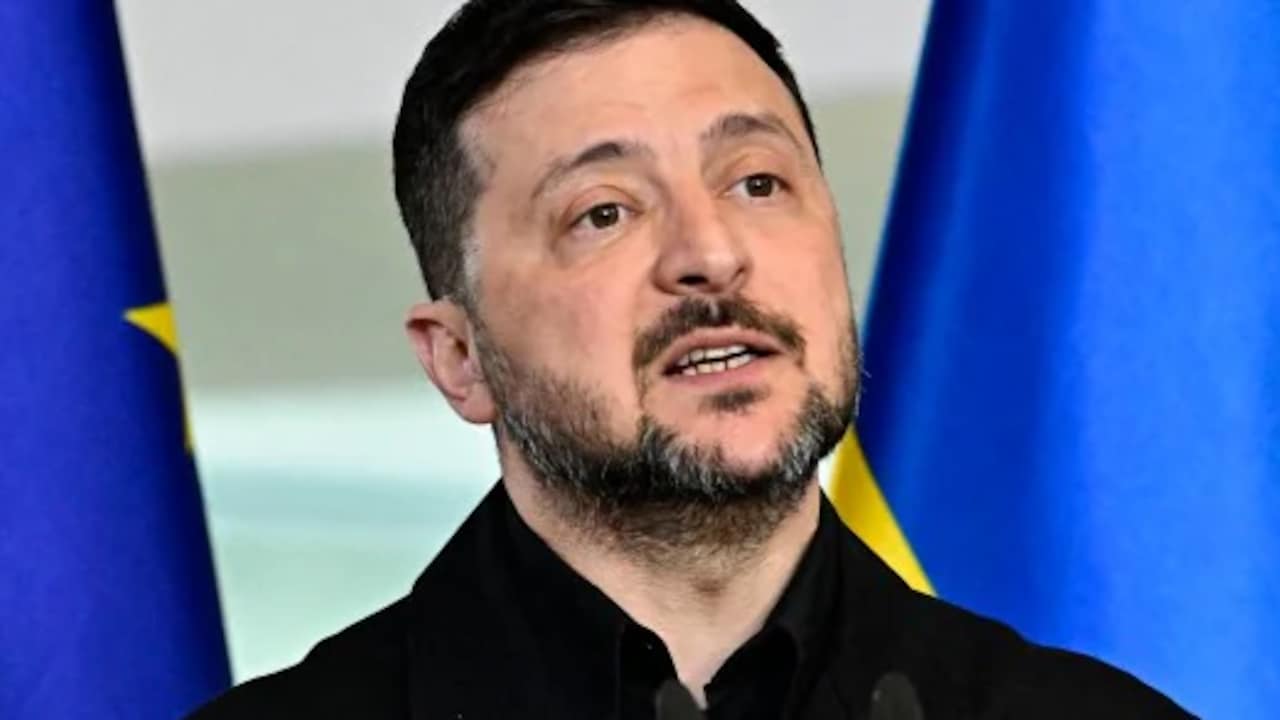
Return to menuIn his remarks to Congress on Wednesday morning, Zelensky renewed his call for the imposition of a no-fly zone over Ukraine, telling lawmakers that doing so would prevent Russian President Vladimir Putin from being âable to terrorize our free cities.â
âRussia has turned the Ukrainian sky into a source of death for thousands of people,â Zelensky said.
The Biden administration has resisted the idea of a no-fly zone, arguing that imposing one could lead the United States into direct combat with Russia.
âFor everything weâre doing for Ukraine, the president also has a responsibility to not get us into a direct conflict, a direct war with Russia, a nuclear power, and risk a war that expands even beyond Ukraine to Europe,â Secretary of State Antony Blinken said earlier this month.
If the imposition of a no-fly zone is âtoo much to ask,â there are alternatives, Zelensky said Wednesday.
âYou know what kind of defense systems we need â S-300 and other similar systems,â Zelensky said, referring to surface-to-air missile systems. âYou know how much depends on the battlefield on the ability to use aircraft â powerful, strong aviation â to protect our people, our freedom, our land. Aircraft that can help Ukraine, help Europe.â
He added: âAnd you know that they exist and you have them, but they are on earth, not in the Ukrainian sky. They do not defend our people.â
In making his appeal, Zelensky also invoked the words of Martin Luther King Jr.
ââI have a dream.â These words are known to each of you,â Zelensky said. âToday, I can say, âI have a need. I need to protect our sky.ââ
Olivier Knox contributed to this report.
âThe destiny of our country is being decided,â Zelensky tells U.S. lawmakers
Return to menuUkrainian President Volodymyr Zelensky said Wednesday that âthe destiny of our country is being decidedâ as he began a virtual address to a gathering U.S. lawmakers.
Speaking from Kyiv, Zelensky said the capital city âis under missile and airstrikes from Russian troops every day.â
âBut it doesnât give up,â he added.
âRight now, the destiny of our country is being decided, the destiny of our people, whether Ukrainians will be free, whether they will be able to preserve their democracy,â he said.
Zelensky said that âRussia has attacked not just us, not just our land, not just our cities. It went on a brutal offensive against our values, basic human values.â
Zelensky appeared on a large screen facing lawmakers gathered in an auditorium of the Capitol Visitor Center. He was greeted by a standing ovation.
In a brief introduction, House Speaker Nancy Pelosi (D-Calif.) praised Zelenskyâs âcourageous leadership.â
The front rows were reserved for congressional leadership and the Ukrainian ambassador to the United States, Oksana Markarova, who chatted with lawmakers before Zelenskyâs remarks.
Many lawmakers were wearing lapel pins with U.S. and Ukrainian flags.
Photos show damage to Kyivâs residential neighborhoods as Russian attacks continue
Return to menuResidential neighborhoods in Ukraineâs capital, Kyiv, have been hit by repeated Russian airstrikes in recent days, as Russian forces have slowly gained ground across the country.
Suspected Russian airstrikes on apartment buildings in Kyiv this week have killed at least six people and injured eight more, local authorities said. The attacks have prompted the cityâs mayor, Vitali Klitschko, to announce a curfew that is set to last until 7 a.m. local time on Thursday. Residents had to be evacuated.
Photos show emergency workers putting out fires in a residential building, with the inside of an apartment destroyed and residents walking through debris.
The prime ministers of the Czech Republic, Poland and Slovenia traveled to Kyiv by train on Tuesday amid the fighting to demonstrate support for Ukraine and met with Ukrainian President Volodymyr Zelensky.
On Sunday and Monday, three journalists were killed and two more injured in two separate incidents outside Kyiv, sparking international condemnation from free-press groups and governments.
Russian forces have moved into areas around the capital, but their advance has not been as rapid as some analysts predicted, with Ukrainian forces preventing them from fully encircling Kyiv.
Sudarsan Raghavan and Jennifer Hassan contributed to this report.
Analysis: The often subtle distinction between anti-U.S. and pro-Putin rhetoric
Return to menuThereâs one point in Ben Collinsâs assessment of the emergence of the U.S.-funded biolabs conspiracy theory that best encapsulates how that theory has been deployed â directly or indirectly to the benefit of the Russian government. The biolabs claims, the NBC News reporter wrote on Twitter, gave âpro-Trump and Q forumsâ an opportunity âto refocus on their major enemies: the Bidens and Anthony Fauci,â director of the National Institute of Allergy and Infectious Diseases.
At the outset of the Russian invasion of Ukraine, there wasnât much gray area. Russian President Vladimir Putin was invading a sovereign nation for trumped-up reasons. There were defenses made, including by Fox Newsâs Tucker Carlson. But that was unsatisfying, particularly for an information ecosystem structured largely around amplifying criticisms of President Biden or downplaying the coronavirus pandemic. And then, from the heavens, a theory about covert weapons research at labs in Ukraine.
Collins traces the route this theory took from a little-noticed post from an anti-vaccine activist on a right-wing social media site to the countryâs most-watched cable news network. But it is worth fleshing out and expanding the point above. Here, at last, was an agreed-upon locus for those looking to question the Biden administration and the government more broadly.
U.S. stock futures point higher as investors eye Fed meeting
Return to menuWall Street was on track for more gains Wednesday, with U.S. markets slated to climb 1 percent or more at the opening bell as investors anticipated the first interest rate increase in years by the Federal Reserve.
The Fed is wrapping up its March meeting Wednesday, where it is expected to announce a quarter-percentage-point increase in its benchmark interest rate. Raising rates is the central bankâs best policy lever against inflation that had soared to a 40-year high even before Russiaâs invasion of Ukraine, which has compounded the issue by causing major disruptions to energy markets that are rippling through the global economy.
âThe central bank has a fine balancing act of taking action to curb inflation while not being too aggressive and tripping up the economy,â Russ Mould, investment director at AJ Bell, said Wednesday in comments emailed to The Washington Post. âThe key question is how many more rate rises weâll get and how quickly they will come. Fast and furious could stall the U.S.âs growth engine.â
Futures were calling for the tech-heavy Nasdaq to pop 1.9 percent at the open, and the S&P 500 to climb 1.3 percent. The Dow Jones industrial average was slated to gain 400 points, or 1.2 percent, extending gains from Tuesdayâs rally, which was fueled by relief over oil prices coming down from recent highs.
Brent crude, the international oil benchmark, was trading 0.3 percent higher Wednesday, around $100 a barrel. West Texas Intermediate crude, the U.S. oil benchmark, was trading up nearly 0.5 percent, around $96.80 per barrel.
Chinese equities saw some major recovery Wednesday after enduring days of steep sell-offs sparked by a covid surge that is threatening to throw more wrenches into the global supply chain and further heat up inflation. Stocks rebounded after officials in Beijing assured the public that the country would work to avert an economic slowdown amid the renewal of business restrictions that have shuttered some of its biggest business and technological hubs.
Hong Kongâs Hang Seng Index rocketed 9 percent higher, while the Shanghai Composite index closed up about 3.5 percent.
Russian TV antiwar protester Marina Ovsyannikova says she fears for her safety
Return to menuMarina Ovsyannikova says she fears for her safety and that of her children following her antiwar protest Monday on Russian television, an act that swiftly went viral as she publicly denounced Russian President Vladimir Putinâs invasion of Ukraine and the Kremlinâs propaganda.
Speaking to Reuters Wednesday, Ovsyannikova, who was a producer for the program she interrupted, said she had concerns over her own safety and that of her family but has no plans to flee Russia.
Ovsyannikova said she hoped her protest was not in vain, and urged people to be mindful of Russiaâs propaganda machine, Reuters reported.
On Tuesday, the day after Ovsyannikova burst onto the set of Russian state TVâs flagship Channel One evening news program, she was found guilty of organizing an illegal protest and fined 30,000 rubles (about $280). It remains unclear if she will face further charges.
Kremlin spokesman Dmitry Peskov dismissed Ovsyannikovaâs actions as âhooliganismâ during a news briefing Tuesday .
Before interrupting the news broadcast Monday, Ovsyannikova, who worked as a producer at the channel, recorded a video message in which she said her father is Ukrainian and her mother is Russian. She described the war in Ukraine as a âcrimeâ and urged Russians to demonstrate.
Spontaneous mass demonstrations are illegal in Russia, where people protesting facing the possibility of fines and jail time.
Protracted conflict could wipe out â18 years of socio-economic achievementsâ in Ukraine, U.N. agency warns
Return to menuIf Russiaâs invasion persists, Ukraine could âfreefall into poverty,â according to an assessment by the United Nations Development Program â wiping out â18 years of socio-economic achievements in Ukraineâ under a worst-case scenario.
The report calls for bolstering the Ukrainian government, in addition to providing humanitarian assistance. More than 3 million Ukrainians have fled their country since Russiaâs invasion began, while the UNDP estimates that more than 7 million could become internally displaced.
In #Ukraine, every day of delayed peace will accelerate a freefall into poverty.
According to our early projections, almost 1/3 of Ukrainians could fall into poverty within a year and an additional 62% are at high risk of falling into poverty: https://t.co/eCPCtgIVF7 pic.twitter.com/nPOJtd4gbJ
The UNDP, which has a team in Ukraine, previewed four economic scenarios. They range from a 7 percent contraction of the economy to a 60 percent collapse during a âsevere and protracted crisis.â That could translate âinto a loss of 18 years of socio-economic achievements in Ukraine and a return back to poverty levels last observed in 2004,â the UNDP said. Its report is one of the earliest attempts to quantify how far back the war could set Ukraine.
Had there been no war, the agency estimates that fewer than 1 million Ukrainians would be living below the poverty line ($5.50 per day) in 2022. Post-invasion, that figure would range from 1.7 million to 11.28 million.
A strong response from the global community could mitigate some of these drastic effects, the UNDP said. It called for âhumanitarian, early recovery, and developmentâ investments.
Hereâs the status of Ukrainian cities under Russian attack
Return to menuNearly three weeks into their invasion of Ukraine, Russian forces are fighting to press forward in a number of cities across the country. Here are updates on some Ukrainian cities:



 English (United States) ·
  Turkish (Turkey) ·