.png)
President Biden, who is traveling to Belgium and Poland this week, has warned that Russia’s tactics may get even more aggressive, as heavy air and artillery bombardments continued to pummel several Ukrainian cities, destroying infrastructure and terrorizing civilians. The Kremlin’s spokesperson refused to rule out the possibility that Russia would use nuclear weapons in the war, telling CNN that Moscow would consider it in the event of an “existential threat for our country,” without elaborating on what that might be.
As fighting continues, the Ukrainian military also said it has retaken the town of Makariv, adding that it has expelled Russian forces from the strategically important town nearly 40 miles west of the capital of Kyiv.
Here’s what to know
European nations plan for refugees; U.N. launches pilot program
Return to menuEuropean nations are bracing themselves for an influx of Ukrainian refugees in the upcoming weeks.
Irish Deputy Prime Minister Leo Varadkar said Tuesday that he expects 40,000 Ukrainian refugees to arrive by the end of April — which would represent a “1 or 2 percent” increase in the country’s population. Ireland has received more than 10,000 refugees who have registered for international protection, Varadakar said Tuesday, according to CNN.
Such an influx could strain Irish education, health care, housing and public finances, Varadkar said. His government has identified about 500 buildings that could be used to house some of the refugees, according to the Irish Times.
Meanwhile, France announced Tuesday that it had launched a national plan to prepare housing for at least 100,000 Ukrainians.
“More and more of them [Ukrainians] are finding refuge in France or transiting through our territory,” French Prime Minister Jean Castex told reporters Tuesday, according to CNN.
More than 26,000 refugees have arrived in France since the beginning of the war, and 10,500 have obtained temporary residency under a recently activated E.U. temporary protection policy, Castex added.
Countries bordering Ukraine, such as Moldova and Poland, have taken most of the influx, which has prompted international organizations including the World Health Organization to ask European nations for help.
On Tuesday, the United Nations High Commissioner for Refugees (UNHCR) and the U.N. International Organization for Migration said some European Union member states have agreed to receive refugees under a pilot program to prioritize the most vulnerable. The organizations are working with several countries to identify and transfer the most vulnerable Ukrainian refugees in Moldova — including people with disabilities, older people, those with severe medical conditions, and mothers with young children, the UNHCR said in a statement Tuesday.
Austria has volunteered to admit 2,000 such refugees, the UNHCR said.
How Russia’s assault on Ukraine is inflaming German fears of hybrid warfare
Return to menuBERLIN — The woman faces the camera, her eyes cast downward, and addresses her appeal to “Russian-speaking Germany.”
“I want to tell you about a boy,” she says in the video, posted on TikTok.
Her tale went like this: The 16-year-old, a Russian speaker, was beaten by a band of Ukrainians at a train station in Euskirchen, a German town nestled in a valley near Cologne. The boy, Daniel, slipped into a coma and died, while the assailants returned to their refugee housing.
She didn’t know the boy, the woman says, but learned of his fate from a friend. “People, he died,” she laments. “I cannot imagine.”
Her claims, German authorities later said, are false. In the 90-second video, the woman doesn’t identify herself, disclose her location or explain the basis for her account. Police said that there was no evidence of such an attack and that the video is fake, “intended to stir up hatred.” State prosecutors are investigating.
Q&A: Americans may be greatly underestimating the impact of 10 years of Putin’s propaganda
Return to menuFew Americans have parsed Russian propaganda on its various platforms like Maxim Pozdorovkin has.
The Russian-born, Harvard-educated filmmaker is behind several works on the subject, most notably “Our New President” from 2018, an award-winning documentary deconstruction of the Russian media’s portrayal of Donald Trump’s election that was, as he puts it, “a movie based entirely on actual footage without a single true statement in it.”
Far from just an attempt to negate discontent over its Ukraine invasion, Russia’s current state-media approach is, in Pozdorovkin’s view, a continuation of a decade-long campaign to warp Russian citizens’ view of the West. He argues that the country’s population has been long primed for this moment — seriously lowering the odds for any tech company or foreign outlet hoping to poke through the veil.
The Washington Post spoke to Pozdorovkin by phone from his home in Brooklyn, where he now lives.
Dow jumps 250 points in Wall Street rally as oil prices level off
Return to menuStocks rebounded Tuesday as energy prices pulled back, with the three major U.S. indexes posting solid gains.
Crude prices swelled as the Russian bombardments in Ukraine intensified but appeared to level off Tuesday. West Texas Intermediate crude, the U.S. oil benchmark, stood at $111 per barrel, down roughly 0.7 percent, after surging more than 6 percent the day before. Brent crude, the global benchmark, was trading near $115 per barrel, down 0.5 percent.
Companies and households have been hit with higher costs at just about every step of the supply chain, particularly the gas pump. Though the U.S. average for a gallon of gas dropped a penny overnight, to $4.24, according to data Tuesday from AAA, it’s still 71 cents higher than a month ago and $1.36 more than a year ago.
The Dow Jones industrial average added 254.47 points, or 0.7 percent, to close at 34,807.46. The broader S&P 500 index jumped 50.43 points, or 1.1 percent, to end at 4,511.61. The tech-heavy Nasdaq climbed 270.36 points, or 1.9 percent, to settle at 14,108.82.
The Dow snapped a five-day winning streak Monday when it fell more than 200 points after Federal Reserve Chair Jerome H. Powell raised the specter of bigger interest rate hikes to beat back decades-high inflation. Last week, U.S. stocks notched their best weekly performance since November 2020, boosted by a cool-down in oil prices that had spiked past $130 a barrel in early March.
How ‘Z’ became a symbol for supporting Russia’s invasion of Ukraine
Return to menuA new pro-Russian symbol is emerging as Moscow continues its assault on Ukraine. The insignia is bold, recognizable and — importantly, according to some analysts — can be painted with one stroke: the letter “Z.”
It first caught the world’s attention when it was spotted on military vehicles clustered along the Russian border with Ukraine in the days ahead of the invasion, which began on Feb. 24.
But it has since been appearing across Russia: spray-painted on buildings, printed on T-shirts, plastered on billboards and brushed onto tanks. Even children are forming Z-shaped lines at schools. Experts say it has quickly become a distinctive symbol of support for Russia’s invasion of Ukraine.
Although the symbol has been officially promoted by the military, and some experts say it appears to be state-directed, they also say there is no way yet to know its origins for sure.
Forest fires near Russian-held Chernobyl nuclear plant raise radiation fears, Ukraine says
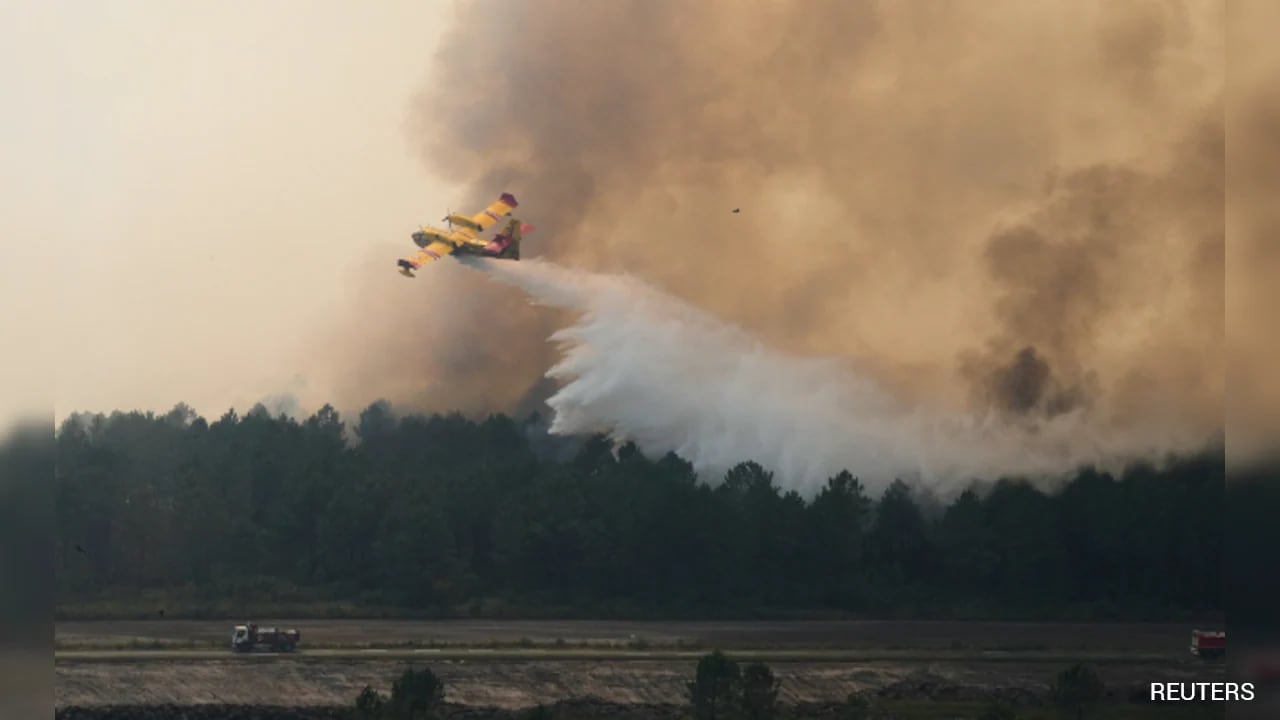
Return to menuForest fires have broken out around the Chernobyl nuclear site, Ukraine’s parliament said Monday, raising fears that radiation could spread from the defunct facility.
At least seven fires within the closed-down plant’s exclusion zone were observed on satellite imagery from the European Space Agency, the parliament said in a statement. The lawmakers blamed the blazes on Russian forces that captured the site in February.
U.S. experts, using NASA satellite imagery, spotted three recent fires in the area. One remains isolated on an island along the Pripyat River, while another has been burning for about a week 20 miles to the west of the site.
These Russians fled to Armenia. They don’t know whether they’ll ever return.
Return to menuYEREVAN, Armenia — As Russia’s economy has plummeted and government restrictions on opposition to the war have increased, Russians have departed their country, suddenly and fearfully, with no time to plan a future or pack cherished belongings. They have left behind families, friends, homes and careers. They are journalists, activists, artists, foodies, mothers and fathers.
Many who made the choice to flee have decamped to this city of about 1 million, where flights are cheap and the cost of living is relatively low compared with capitals in nearby countries. A growing sense of limbo has set in. They spoke to The Washington Post about the whiplash of their exit, the pain of leaving loved ones behind and the difficulty of squaring their national identity with Russia’s invasion.
Technology united these Russians and Ukrainians. Now, they’re trying to stay connected as war scatters them.
Return to menuUntil a few weeks ago, Jacob Udodov’s software start-up was a symbol of Eastern Europe’s promising tech economy. From his base in Latvia, he built a team of developers in Ukraine and Russia who proved that the tech industry can work seamlessly across borders, Udodov said, “not tied to any location.”
That all changed at 8 a.m. on Feb. 24, when his wife shook him awake to say that Russian bombs were raining down on Ukraine. Udodov quickly opened his company’s group chat and urged his Ukrainian programmers to head west to the safest location.
“My employees sent me a map of the aerial bombardment,” Udodov recalled in a recent interview. It showed strikes all across the country, from Lviv to Kharkiv. “They sent me this map and said there is no safe destination in Ukraine.”
Nearly a month later, the Ukrainian employees of his start-up, Bordio, are taking cover in bomb shelters, struggling with power and Internet cuts and saying goodbye to family members as the civilian population scatters to escape Russian troops. Two of Bordio’s Russian programmers have fled their country in alarm over Russia’s military action and authoritarian tilt, while the ones remaining in Russia are struggling to receive their paychecks amid Western banking sanctions.
Bordio’s troubles are just one example of how Russia’s invasion of Ukraine is threatening the digital modernity that had taken root across much of the former Soviet Union.
Who is Alexei Navalny, the Kremlin critic serving time in a Russian penal colony?
Return to menuAlexei Navalny, 45, is Russia’s best-known opposition leader. He has become the international figurehead of dissent against Russian President Vladimir Putin.
Navalny was jailed in January 2021 when he flew back to Russia after recovering in Germany from a poison attack in August 2020 with the nerve agent Novichok. He has blamed Russian security forces for the poisoning, as have U.S. and European authorities. Russian officials have denied any role. He was sentenced to more than 2½ years in prison in part for breaching probation rules by going to Germany for the treatment, a ruling his supporters say is entirely political.
On Tuesday, a court found him guilty of fraud and contempt and sentenced him to an additional nine years in prison. It is not clear yet whether the two sentences will be combined. Navalny and his team argue that the charges are fabricated and that he’s being persecuted.
What you need to know about Navalny and his imprisonment.
White House press secretary Jen Psaki to miss Biden’s Europe trip after testing positive for coronavirus
Return to menuWhite House press secretary Jen Psaki said Tuesday that she had tested positive for the coronavirus and would be pulling herself from a planned trip to Europe with President Biden and other administration officials.
“Today, in preparation for travel to Europe, I took a PCR test this morning,” Psaki tweeted Tuesday afternoon, shortly before a news briefing at which she was scheduled to appear. “That test came back positive, which means I will be adhering to CDC guidance and no longer be traveling on the President’s trip to Europe.”
On Twitter, Psaki said that she had two “socially-distanced meetings” with Biden on Monday, and that Biden was not considered a close contact as defined by the Centers for Disease Control and Prevention. Biden tested negative Tuesday for the coronavirus, Psaki added.


 English (United States) ·
  Turkish (Turkey) ·