.png)
To the moon, again!
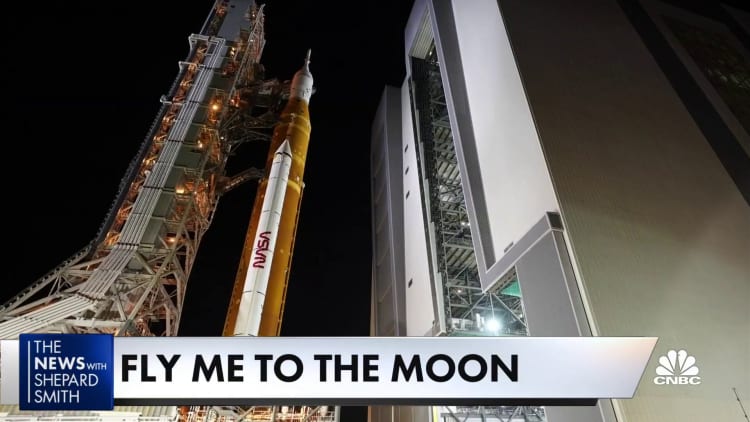
NASA launched the Artemis I mission on Wednesday from Florida, with the agency's most powerful rocket ever kicking off a nearly month-long journey with a ground-shaking liftoff.
So far the mission is going as planned, reaching orbit around the Earth, but multiple milestones are yet to come.
While no astronauts are onboard, the Space Launch System (SLS) rocket is carrying the Orion capsule on a demonstration for NASA's lunar program. Artemis I will not land on the moon, but the spacecraft will orbit nearby before returning to Earth in 26 days.
The mission represents a crucial inflection point in NASA's moon plans, with the program delayed for years and running billions of dollars over budget. The Artemis program represents a series of missions with escalating goals, with the third â tentatively scheduled for 2025 â expected to return astronauts to the lunar surface for the first time since the Apollo era.
Artemis I will now travel about 1.3 million miles over the course of 42 days. The Orion capsule will separate from the SLS rocket, and leave Earth's orbit en route to the moon. NASA plans to fly Orion as close as 60 miles above the moon's surface, before moving into a wide orbit around the lunar body. To return, Orion will use the moon's gravity to assist it in setting a trajectory back into Earth's orbit.
NASA first tried to launch Artemis I in August but has called off multiple attempts since then after discovering technical problems with the rocket's engines.
In September the agency rolled the rocket back into the Vehicle Assembly Building (VAB) for protection from Hurricane Ian, returning the vehicle to the LC-39B launchpad on Nov. 3.
Last week, NASA left SLS and Orion out on the launchpad to weather the winds of Hurricane Nicole.
NASA said it checked the rocket and spacecraft after the storm passed and found no major damage to the vehicle. It said a 10-foot section of insulation near the Orion capsule had pulled away due to the high winds â but NASA decided to proceed with Wednesday's launch attempt after an analysis showed it was not expected to cause any significant damage if the insulation falls off during the launch.
A host of aerospace contractors support the hardware, infrastructure and software for SLS and Orion â with Boeing, Lockheed Martin, Northrop Grumman, Aerojet Rocketdyne, Airbus and Jacobs leading the effort.
NASA's program has enjoyed strong bipartisan political support, but the agency's Inspector General recently warned that Artemis is not a "sustainable" way to establish a presence on the moon. The internal watchdog found that more than $40 billion has already been spent on Artemis, and projected NASA would spend $93 billion on the effort through 2025 â when the first crewed landing is planned.






 English (United States) ·
  Turkish (Turkey) ·